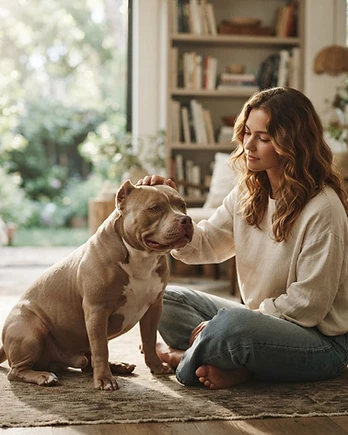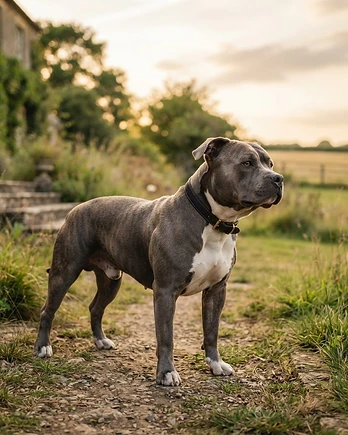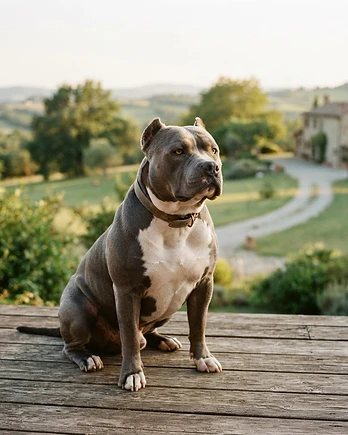
There's a moment that happens in nearly every family that brings home an American Bully for the first time. A toddler waddles over, reaches out a chubby hand, and grabs a fistful of wrinkled dog face — and the Bully just... melts into it. No growl. No flinch. Just a deep sigh and maybe a slow tail wag, as if to say, finally, someone my size. If you've witnessed it, you already know. If you haven't, you're about to understand why so many families across the country are choosing the American Bully as their forever companion.
We get asked constantly — by first-time dog owners, by parents of young kids, by apartment dwellers, by retirees — "Is an American Bully really a good family dog?" The honest answer, the one we've lived and witnessed for years through our breeding program here in Austin, Texas, is a resounding yes. But with an important caveat: the right Bully, raised the right way. Temperament doesn't happen by accident. It's the product of ethical breeding, early socialization, thoughtful training, and a home built on trust. When all of those things align, the American Bully is one of the most remarkable family dogs on the planet.
This article is our attempt to give you the full, honest picture — not marketing language, not exaggeration, but the real story of what life with an American Bully looks like, why they're so well-suited to family life, and what you should know before bringing one home. Whether you're still in the research phase or you're already falling in love with one of our available American Bully puppies, we hope this gives you clarity and confidence.
The American Bully Temperament: What the Breed Was Built For
The American Bully is a relatively young breed — formally recognized by the ABKC in 2004 and the UKC in 2013 — but it was purpose-built from the ground up with family life in mind. Developed from American Pit Bull Terrier and American Staffordshire Terrier lines (with careful infusions of other breeds for structure and temperament), the Bully was deliberately bred away from gameness and drive, toward companionship, stability, and affection.
The result is a breed with a temperament profile that's genuinely unusual in the dog world: physically imposing but emotionally soft, confident but not dominant, energetic but not manic. The ABKC breed standard explicitly calls for a dog that is "gentle and loving toward people" — and responsible breeders take that mandate seriously.
Key Temperament Traits of the American Bully
- Exceptionally people-oriented. Bullies don't just tolerate human company — they crave it. They are not dogs who do well isolated or ignored. They want to be with you.
- Naturally gentle with children. A well-socialized Bully typically exhibits extraordinary patience with kids. They tend to match the energy of young children without tipping into rough play.
- Loyal without being possessive. They form deep bonds with their families but are not typically resource-guardy or clingy in an unhealthy way.
- Low reactivity. Compared to many working breeds, well-bred Bullies have a calm, measured response to novel stimuli — less likely to overreact to sudden sounds, chaos, or commotion.
- Adaptable. From small apartments to sprawling backyards, Bullies adapt to their environment with surprising ease, provided their social and moderate exercise needs are met.
Are American Bullies Safe Around Children?
This is the question most parents need answered directly, so let's address it head-on.
Yes — a well-bred, properly socialized American Bully is exceptionally safe around children. In fact, many experienced dog owners describe the Bully as one of the most instinctively gentle breeds they've encountered with kids. There's a reason they've earned the informal nickname "nanny dog" in some communities (a title historically applied to Staffordshire Bull Terriers for similar reasons).
That said, responsible ownership means never leaving any dog unsupervised with very young children — that's not a Bully-specific caution, it's a universal one. Children should also be taught how to approach and interact with dogs respectfully. With those baseline practices in place, the American Bully is about as safe and loving a family dog as you'll find.
What Research and Temperament Testing Show
The American Temperament Test Society (ATTS) has historically shown Bully-type breeds passing at rates comparable to or higher than many popular family breeds. While breed-wide statistics have limitations, they reinforce what breeders and owners observe daily: these dogs are not naturally aggressive toward people. Aggression toward humans is considered a serious fault in the American Bully breed standard and is actively selected against by ethical breeders.
At Monolith of Tenderness, every dog in our breeding program is health-tested and evaluated for temperament before being used in a pairing. You can learn more about what that process looks like in our guide on Health Testing: What Responsible Breeders Check For.
The Role of Breeding in Family Suitability
Here's something we want every prospective owner to understand deeply: not all American Bullies are created equal. Temperament is heritable. It's also shapeable — but the foundation starts at the genetic level, long before a puppy takes its first breath.
A puppy bred from calm, people-loving, human-socialized parents in a clean, enriched whelping environment has a dramatically different starting point than one bred carelessly for appearance alone. This is why the breeder you choose matters more than almost any other factor in the equation.
When you look through our individual puppies — like Atlas, our Lilac Tri-Color Male, Ella, our Lilac Tri Female, or Hazel, our stunning Merle Female — you're not just looking at coat colors and build. You're seeing the result of deliberate, health-tested pairings designed to produce dogs that are sound in body and mind.
What to Look for in a Responsible Breeder
- ABKC and/or UKC registration (not just "papers" from unrecognized registries)
- Health testing of parent dogs (hips, elbows, cardiac, eyes at minimum)
- Early neurological stimulation and socialization of puppies
- A clean, enriched raising environment — not kennels or cages
- Willingness to answer questions and stay connected after adoption
- A written health guarantee
You can read more about our breeding program and the standards we hold ourselves to.
Socialization and Training: Your Part in the Equation
Even the best-bred Bully needs guidance. The great news is that American Bullies are remarkably trainable — they're eager to please, food-motivated, and highly attuned to their owner's emotional state. They want to get it right. Your job is to show them how.
Early Socialization Is Non-Negotiable
The critical socialization window for puppies is roughly 3–14 weeks of age. During this period, positive exposure to different people (including children of various ages), sounds, environments, surfaces, and animals shapes the dog's baseline confidence and emotional responses for life. Puppies from Monolith of Tenderness begin this process before they leave our care — but you'll need to continue it diligently once your puppy comes home.
Our guide on Bringing Your American Bully Puppy Home: The First 48 Hours walks you through exactly how to set the tone from day one.
Training Philosophy Matters
American Bullies respond best to positive reinforcement — reward-based methods that build trust and clarity without fear or intimidation. Harsh corrections can undermine the sensitive, people-pleasing nature that makes this breed so wonderful with families. We strongly recommend our resource on Gentle Training for a Confident Bully as a starting point for new owners.
Basic obedience (sit, stay, come, leave it, leash manners) isn't just about convenience — it's about safety and relationship-building. A Bully who knows the rules is a happier, calmer, more confident dog.
Life With an American Bully: What to Actually Expect
Let's paint a realistic picture of day-to-day life, because you deserve honesty, not a highlight reel.
Exercise Needs
American Bullies are moderately active. They're not Border Collies — they don't need hours of daily exercise. But they do need consistent movement: two solid walks per day, some play sessions, and mental stimulation. Without adequate activity, any dog can develop boredom behaviors. With it, Bullies are remarkably settled indoors.
Living Situation
Bullies adapt well to apartment living if their exercise needs are met. They're not excessive barkers, and their calm indoor demeanor makes them manageable in smaller spaces. That said, a yard for play is always a bonus.
Other Pets
This varies by individual dog and socialization history. Many American Bullies coexist beautifully with other dogs and even cats when raised with them. Some can be selective with unfamiliar dogs, particularly of the same sex. Early, positive introductions matter enormously here.
Nutrition and Health
A well-nourished Bully is a healthy, happy Bully. These dogs have specific dietary needs that support their muscular build and coat. Our Feeding Your American Bully: A Nutrition Guide covers everything from protein ratios to meal frequency to supplements worth considering.
Quick Checklist: Is an American Bully Right for Your Family?
- ✅ You want a loyal, affectionate dog who bonds deeply with the whole family
- ✅ You have children (of any age) and want a patient, gentle companion for them
- ✅ You can commit to daily exercise and consistent training
- ✅ You have time for socialization, especially in the first year
- ✅ You're looking for a calm, adaptable indoor dog with a manageable energy level
- ✅ You want a breed with low reactivity and a stable, predictable temperament
- ✅ You're prepared to invest in quality nutrition, veterinary care, and enrichment
- ⚠️ You work extremely long hours with no one home — Bullies need company
- ⚠️ You want an independent, low-interaction dog — Bullies thrive on connection
Meet Some of Our Family-Ready Puppies
Every puppy we raise at Monolith of Tenderness is handled daily, exposed to household sounds and activity, and evaluated for temperament from the time they're born. Right now, we have some extraordinary puppies looking for their forever families:
- Atlas — Lilac Tri-Color Male American Bully puppy — a striking, confident boy with a soft, loving disposition
- Bowie — Blue Tri Male American Bully puppy — bold in color, gentle in spirit
- Diesel — Chocolate Tri Male American Bully puppy — rich, rare coloring paired with a steady, calm nature
- Ella — Lilac Tri Female American Bully puppy — one of our most affectionate, people-loving girls
- Hazel — Merle Female American Bully puppy — breathtaking pattern, sweet and curious temperament
Curious about what makes their colors so special? Check out our guide to American Bully Coat Colors: Lilac, Blue, Tri & More Explained.
The Bottom Line
The American Bully is not a misunderstood danger in disguise. It is not a status symbol, a guard dog, or a breed that needs to be feared. At its best — bred with care, raised with intention, and loved with consistency — the American Bully is one of the warmest, most devoted family dogs you will ever share your life with.
They will follow your kids around the yard. They will sleep at the foot of the bed. They will press their wide, wrinkled heads into your lap after a hard day. They will make strangers smile at the park and make your family feel complete in a way you didn't expect.
If you're ready to take the next step, we'd love to walk alongside you. Browse our available American Bully puppies, read through our adoption guide to understand our process, or explore our full resource library to keep learning. And when you're ready to talk, we're always here — just contact us and let's find the right match for your family.
Your Bully is out there. We'd be honored to help you find them.